Thursday, April 3, 2014

Part 3: The Mother Tongue

Inside Joke: "Are you straightforward?"

Wow, awesome book! The Mother Tongue has taken me on quite a journey through English, my native language. The second half explores Old and Middle English, the origin of names of countries, and yes, even swears! 

I originally thought the book would take me longer to read than it did, but the last fifteen pages of the book are comprised of a select bibliography and an index (characteristics of a non-fiction book). I'm very glad that I was able to finish it in time to finish this last blog post, and although I rushed a bit, I truly enjoyed the book. I would recommend it to anyone interested in knowing more about the English language, however, it is heavily evidence-based and Bryson incorporates a lot of historical events that complement the evolution of our language. So, if you're not keen on reading a somewhat hard-core non-fiction book, and learning more history and knowledge than your mind has the capacity for, then don't ever consider picking The Mother Tongue up. Trust me, you won't like it.

I found the end quote very interesting, and I'd like to share it with you:

"If we should be worrying about anything to do with the future of English, it should be not that the various strands will drift apart but that they will grow indistinguishable. And what a sad, sad loss that would be." (Bryson 245)

Even though many people strive to speak the "same English" as everyone else, Bryson's message is that the different accents, the different dialects, the different vocabulary, and the different methods of speaking English are what make this language so unique and universal. After all, varieties of English are what makes us us, what distinguishes you from me. Each and every one of our own unique version of English represents our culture and most importantly, ourselves. 

Who knows what English will be like in the future? One day, the English I am writing and speaking to you in, may become what generations in the future refer to as "old English" or "middle English". Will English still be the global language since many have predicted that Chinese will take English's current title? The future of our language, as well as every language in the world, is critical and it will define our society for centuries to come.

So there are a bunch of people I'd like to thank that really helped out during the creation and making of this blog:
For all of my dedicated blog readers: please click here to see my special message for you
To Google, for messing up the font and text size on most, if not all, of my blog posts: this is for you
For Mr. P, this will be my face if I don't get an A on this project: click here
For all of you who contributed to the 400+ views on this blog: click here


Picture Source ("jayus): http://24.media.tumblr.com/f15c4bc53ab94832e1b8746ae39f8677/tumblr_mtob0hZP6b1qlariio1_500.gif

Wednesday, April 2, 2014

Part 2: The Mother Tongue

 http://facultywp.ccri.edu/panaccione/files/2011/10/poster.jpg
World Languages = World People

So far, The Mother Tongue has been very insightful and interesting. It has educated me on the pros and cons of the English language, the origins of English, how English words came to be, and much, much more. Bryson's style is informative and succinct, and very easy to comprehend. While I was still in the stage of reading the beginning of the book, I had a reminiscent feeling of a book I had read not too long ago. In fact, that book was David and Goliath. Just as Bryson's writing flowed naturally and was easily comprehensible, Gladwell's writing was comprised of short sentences that made his books easy to read. They both include evidence and research (quotes, citations, etc.), and they analyze the evidence. The only difference between the two authors, is that Bryson incorporates some of his small, joking remarks within parentheses, as shown below:

"What a Briton calls a blizzard would, in Illinois or Nebraska, be a flurry, and a British heat wave is often a thing of merriment to much of the rest of the world. (I still treasure a London newspaper with the banner headline: BRITAIN SIZZLES IN THE SEVENTIES!)" (Bryson 15)

These humorous comments are what may be written off by Mr. P as "style errors", but to the reader, especially in a book dense with information and facts, these parenthetical phrases are positively refreshing. In my opinion, humor is always good. 

Additionally, Bryson provides the reader with dumbfounding information about English that the reader, if English is his or her mother tongue, will most definitely open their mouths in complete awe. Please consider the following:

 "But perhaps the single most notable characteristic of English--for better and worse--is its deceptive complexity. Nothing in English is ever quite what it seems. Take the simple word what. We use it every day--indeed, every few sentences. But imagine trying to explain to a foreigner what what means. It takes the Oxford English Dictionary five pages and almost 15,000 words to manage the task...As native speakers, we seldom stop to think just how complicated and illogical English is. Every day we use countless words and expressions without thinking about them--often without having the faintest idea what they really describe or signify." (Bryson 19)

If someone asked me what what means, I would try to explain its meaning without getting much farther than "It's a question word...Ugh just use Google translate." But come to think of it, this is true of our language. We go about our daily lives, using words that we probably don't even fully understand (what's really crazy is that Oxford English Dictionary had to use 15,000 words to explain the word what...)! So readers, as a fun little activity, please consider the meaning of the word "the" and comment what you think the meaning is WITHOUT LOOKING IT UP! No cheating!

While The Mother Tongue, yes, blows my mind with its amazingly incredible insight, it also includes great writing and yet, more incredible insight:

"And yet it survived. If there is one uncanny thing about the English language, it is its incredible persistence. In retrospect it seems unthinkable, to us now that it might have been otherwise, but we forget just how easily people forsake their tongues...It is a cherishable irony that a language that succeeded almost by stealth, treated for centuries as the inadequate and second-rate tongue of peasants, should one day become the most important and successful language in the world." (Bryson 56)

Our language and its survival skills truly amaze. It's hard to imagine a time when English was only used by the lower-class, now that English is practically the World's Language. Also, take note of Bryson's writing. As I mentioned earlier, it is very streamlined, easy to read, and informative at the same time. I love his use of vocabulary: "forsake their tongues", "cherishable irony", etc. His style makes this book an enjoyable read!

Almost my last post for this project! Thanks for reading, guys!

My beautiful-word-definition of the day:


Picture source ("languages"): http://facultywp.ccri.edu/panaccione/files/2011/10/poster.jpg
Picture source ("la douleur exquise"): http://editorial.designtaxi.com/news-notranslate0608/5.gif

Saturday, March 29, 2014

Part 1: The Mother Tongue

 
English: The only language with the word "artsy-fartsy"

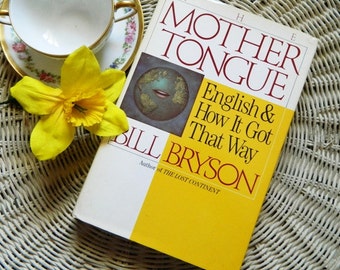
While rummaging through book at home, I happened across the book shown above. The title immediately sparked my interest (after all, English is my mother tongue). I am hoping that The Mother Tongue will add to my knowledge of English, the universal language, and allow me to become a better writer. I have lots of high expectations, considering my parents praised this book highly when I told them I was going to read it. On top of that, the back of the book reads:

"Bill Bryson has joyfully mined the rich ore of English to produce a treasure of a book about the treasure of our tongue." --Richard Lederer, author of Crazy English

Bill Bryson was an American journalist who worked for The Times, in London, and The Independent. He wrote many bestselling travel books, including The Lost Continent, which documented his journey around the United States from 1987 to 1988. His books include A Dictionary of Troublesome Words, A Walk in the Woods, and A Short History of Nearly Everything.

I will also be starting a "beautiful-word-definition" for the posts of The Mother Tongue (I find doing this is relevant to the book), so here we go:


Links:

Picture Source ("The Mother Tongue"): https://img0.etsystatic.com/032/0/6776881/il_340x270.570389374_jz2c.jpg
Picture Souce ("fernweh"): http://img.pandawhale.com/post-25612-fernweh-meaning-gif-aDM0.gif

Wednesday, March 26, 2014

Part 3: 1984

Next, they'll be saying "2 + 2 = 5"...Oh wait, they already did.

Am I feeling depressed today? Why, yes I am. Thanks to George Orwell's 1984, I'm feeling very, very depressed (this means you can assume that there will be majorly-extreme (yeah, obviously that's not proper grammar...I think...) SPOILER ALERT, aka you'll know the ending of the book by the end of this post). Considering I had a weird feeling after reading Animal Farm, this really is no surprise to me. 

The contradictory phrases shown in the picture above compose the slogan of the Party. Let's start out with "War is peace". In Oceania, that is somewhat true. In the beginning, there is a "war" (this is what the Party tells everyone) between Oceania and Eurasia (the enemy shifts to Eastasia later on, which shows how unreliable the Party is). This war unites all of the people against their enemy, so there is less fighting between "Oceanians" (just to clarify, I made that word up and I'll use it when I'm referring to the citizens of Oceania). Not only that, the Party forces the Outer Party Members to watch the Two Minutes Hate. During this time, the face of Emmanuel Goldstein, who is supposedly a traitor and the dominant enemy of Oceania, appears on a telescreen. Everyone watching is allowed to scream and curse at his face. In my opinion, this is genius. It's a great way for Oceanians to vent their emotions, so they won't feel the need to go against the Party, and to unite everyone. Next, "Freedom is slavery". All Oceanians are slaves to the Party, and because of this, they are free from the dangers of choice and free will. Other than that, I don't have much to say about this phrase. The Party probably incorporated it into their slogan in order to trick Oceanians into thinking that the way they were scrutinized and controlled by the Party was acceptable and tolerable. Lastly, "Ignorance is strength". Since Oceanians tolerate the Party's ruthless hold, this ignorance has strengthened the Party's rule.

While Animal Farm portrayed Communism in Russia, I felt that 1984 was symbolic of Nazi rule. Big Brother, the dictator of Oceania and ruler of the Party, symbolizes Adolf Hitler. Revisit the picture in the second post of Big Brother, and the mustache gives you a definite feeling of recognition, doesn't it? Not only that, the Party blames all of Oceania's troubles on Goldstein while Hitler blamed

Germany's troubles on Jews. This rallied all of the people against a common enemy and united them (just as I explained above in "War is peace"). It gets even better. Just as the Party has propaganda posters with Big Brother's face plastered everywhere, Nazi propaganda was just as prevalent. Whenever Hitler gave a speech (look it up on YouTube), the Germans were completely hypnotized by his voice, just as Oceanians love and cherish Big Brother. 

In the climax (here is the majorly-extreme SPOILER ALERT as I said I would include earlier), just as I predicted in the second post, Winston and Julia are caught by the Thought Police. An old man, Winston thought he could trust, turned out to be a secret-Thought-Police-agent. And not only that, O'Brien, who Winston thought was a member of the Brotherhood (rebels against Big Brother, supposedly led by Goldstein), was actually a loyal Party member. Part of O'Brien's job was to trick Oceanians, who wanted to join the Brotherhood, into thinking he was a member of the Brotherhood, then stabbing them in the back by capturing them. In a world where the government spies on all of its citizens and preys on their every move, everyone must wear masks and hide their inner and true selves. The following quote is an example of how Winston keeps his cool when telescreens are nearby:

"Winston turned round abruptly. He had set his features into the expression of quiet optimism which it was advisable to wear when facing the telescreen." (Orwell 7)

Sure, lots of websites say that 1984 depicts the consequences of a totalitarian government in the future, but it depicts our society too! Just as Winston must portray an image, the "good and obedient" citizen, we reflect a certain image of ourselves to othersIt's purely human nature. We pretend to be someone we're not in order to impress others and hide our inner selves. While Oceanians do it so that they are not vaporized, we may hide behind our faces in light of a social and/or life-or-death matter. 

After he is captured, Winston is thrown in a cell for a long time and tortured by O'Brien. O'Brien's goal is to alter Winston's mind into loving Big Brother and make him become an obedient slave. Although Winston tries to hold it out and tries to stick to his gut, he fails to stand up against O'Brien, especially when he is experiencing an enormous amount of pain. In the end, Winston succumbs to the dark side. This quote, from the last page of the book, exemplifies his love for Big Brother: 


"[Winston] gazed up at the enormous face [Big Brother]. Forty years it had taken him to learn what kind of smile was hidden beneath the dark moustache. O cruel, needless misunderstanding! O stubborn, self-willed exile from the loving breast! Two gin-scented tears trickled down the sides of his nose. But it was all right, everything was all right, the struggle was finished. He had won the victory over himself. He loved Big Brother." (Orwell 375-376)

Well, if you can't beat them, you might as well join them. See why I'm so depressed? Most dystopian books I've read are written so that the good guys win in the end. In 1984, the bad guys win! This dark ending demonstrates how the novel serves more as Orwell's premonition of the future and his warning to the world, than an entertaining and "And-they-lived-happily-ever-after" story.

Time for a Kurt Vonnegut story arc! This is what I believe represents 1984:


In the beginning, everything's just dandy. Winston goes to work, comes home, writes in his journal, etc. Then, things get better bit by bit when he meets Julia and begins to have a secret relationship with her. Winston is happy with her, but wait--there's more! Winston and Julia visit O'Brien in his apartment and tell him that they want to join the Brotherhood. Finally, they have hope that the world can be better when O'Brien "enlists" them and Winston receives the book...but oh no. O'Brien is actually a secret agent working for the Party. The story plunges down into a deep hole as Winston and Julia are captured by the Thought Police. What's even more depressing (as I've mentioned before), is that the book ends with Winston loving Big Brother. 

"And I believe that totalitarianism, if not fought against, could triumph again." -- George Orwell
Quote Source and essay about Orwell: http://www.theorwellreader.com/essays/sedlak.html

How soon could a loveless and heartless world of totalitarianism come into existence? Sooner or later we could all be under the rule of a ruthless dictator, Orwell forewarns in the quote above. But is this true? I have doubts that the United States will become a totalitarian government any time soon, since we Americans love to pride ourselves in our "democracy" and "republic". Additionally, we love to get our hands dirty with the doings and affairs of other countries, especially if it involves a dictator, a Communist party, the oppression of the people, a lack of human rights, etc. Although 1984 was a serious good-mood killer, there are deep lessons hidden among the pages. If only Orwell had written an allegory about Communist China...I would read that.

Picture (at top of page) Source: http://affordablehousinginstitute.org/blogs/us/wp-content/uploads/1984_2_2_small.jpg

Sunday, March 23, 2014

Part 2: 1984

Before the NSA, we had this...

Is it me, or does Orwell have a personal vendetta against Communism/totalitarian governments? One-hundred and seventy pages in, and already, I've lost myself to this alternate world of constant surveillance, men and women who have been deprived of their simple pleasures in life (I shall refer to them as the “stiffs”, aka those who work in the various Ministries and Departments, aka Outer Party Members), and stiff rules/laws.

The main character/protagonist, Winston Smith, is a 39-year-old man working in the Ministry of Truth. His job is to change news articles, especially those in "The Times" (not a very creative name...I'm pretty sure it's trademarked...), in order to suit the Party’s (ring a bell? hint, hint...Communism) ulterior motives. For example, Winston may have to rewrite an article about someone who the Party vapored and omit references to the person as if they never existed in the first place. SPOILER ALERT: While he is walking in the halls of the Ministry, he is approached by a young girl working in the Fiction Department and she places him a mysterious note that says: “I LOVE YOU”. They begin to have a relationship while plotting to overthrow the Party at the same time.

So far, the plot has been slow up until Winston and Julia (the name of the young girl) began having a relationship. I really hope there will be more action later on...I’m more of an action person; I’d rather read a book where there are guns blazing and people fighting, than a book where everything is in slow motion. What’s even worse, is a book where there is supposed to be action but there is NONE (hint, hint 1984)! Almost every dystopian/futuristic novel I’ve read has had some sort of violence and I am somewhat disappointed. Also, I had a premonition (while Winston and Julia were together) that Winston or Julia would be caught by the ThoughtPolice and be vaporized. My money’s on Julia to die before the book is over, and Winston to die at the end.

As I mentioned in the first post, I have already read Animal Farm (also by Orwell). For Animal Farm, it was more allegorical and more fable-y, while 1984, was more of a dystopian world. 1984 and Animal Farm are similar, since they both shed a negative and dark light on totalitarian governments. Also, the “governments” (considering that animals had some form of a government/hierarchy) in both books had slogans/manifestos. Compare the Party’s slogan from 1984 to the animals’ manifesto from Animal Farm:

The other day in German class, we watched a video about Ka De We, the largest department store in Germany. It is very high-end, and the 2,000 employees work day-to-day, trying to create the perfect shopping experience for their customers. The video focused on the maintenance man, who fixed various problems, from cleaning a water tank in the seafood section to restoring water to the restroom in a restaurant, as quickly as possible. This way, the customers would not get angry from their experience and never come back. We also saw one of the designers checking the displays in the clothing section of the store. I noted that he was very critical about other designers’ works. He commented negatively on jeans that were not evenly spaced when hung and price tags that were showing on a display (my response was: “This is not design. This is OCD.”). While we were watching, I made an immediately connection to 1984. Just as high-end department stores, such as Ka De We, create a seemingly “perfect” world, there are many “behind-the-scenes” happenings in order to hide the many imperfections and flaws. The maintenance man reminded me of Winston. Both do the “dirty work” of the higher power at play (employer/the Party) and both wear blue overalls! (The maintenance man in the video wore blue overalls, which happens to be Winston’s uniform in the book. Our German teacher told us that the blue overalls were actually the uniform of maintenance men in Germany.) The designer, on the other hand, reminded me of the Party in the book. He inspected and checked all of the doings of his subordinates to make sure that all was perfect for the customers (in 1984, I imagine the customers in Ka De We to represent the people of Oceania).

While Winston lives in such a seemingly flawless, yet cruel world, he dreams of a safe haven:

“The inexhaustibly interesting thing was not the fragment of coral but the interior of the glass itself. There was such a depth of it, and yet it was almost as transparent as air. It was as though the surface of the glass had been the arch of the sky, enclosing a tiny world with its atmosphere complete. He had the feeling that he could get inside it, and that in fact he was inside it…The paperweight was the room he was in, and the coral was Julia’s life and his own, fixed in a sort of eternity at the heart of the crystal.” (Orwell 184-185)

The paperweight (a piece of coral inside crystal) is an old artifact that Winston buys from a small shop. The true past of the world, not what the Party force-feeds the citizens of Oceania, constantly intrigues him. Within the paperweight, he is able to lose himself and imagine a world where there is free will and free love. I believe Winston's hope for the world to change will be the driving force that causes him to act rashly in some situation, which will, as I mention again, lead to his death. 

In the exposition of the story, Winston opens his newly-bought diary and begins to write in it. I was reminded immediately of the old and famous adage: "The pen is mightier than the sword". Even though Winston does not outwardly rebel the Party, he has committed “thoughtcrime” by being against the Party in his mind. He begins to keep a diary that outlines his inner and true thoughts about his current world. Winston wonders who he’s writing to in this quote:


“He wondered again for whom he was writing the diary. For the future, for the past—for an age that might be imaginary. And in front of him there lay not death but annihilation.” (Orwell 35)

Here, Winston realizes that no matter who is audience is, the path he is taking will ultimately lead to death. Deep down he knows that the Thought Police will eventually find that he has committed thoughtcrime and vaporize him and the diary altogether. The bird singing in the following quote, symbolizes Winston:

“The music went on and on, minute after minute, with astonishing variations, never once repeating itself, almost as though the bird were deliberately showing off its virtuousity…Winston watched it with a sort of vague reverence. For whom, for what, was that bird singing?...What made it sit at the edge of the lonely wood and pour its music into nothingness?” (Orwell 156)

Just as the bird's sweet music is being "poured into nothingness", Winston's efforts to somehow warn the future through his diary are in vain as well. As I said earlier, I had a premonition that Winston would be captured and killed at the end of the book. I see this metaphor, of the bird as Winston, as foreshadowing for something horrible that may occur later. 

While I was talking to my Language Arts teacher, he mentioned that George Orwell and Aldous Huxley, the author of A Brave New World, had exchanged letters and argued about which world they created would eventually become the future of the world. Orwell argued for the world of 1984, where the government kept the people in control by taking away all of man’s pleasures away. On the other hand, Huxley argued for the world of A Brave New World, where the government kept the people in control by giving them everything they desired. Both standpoints are interesting and I believe they have both integrated themselves into today’s modern society. In light of Orwell’s argument, governments all over the world have spy agencies that evaluate and scrutinize the actions of the people (supposedly to sift out terrorists from society). The United States have the NSA, Britain has CCTV and etcetera and etcetera. But in light of Huxley’s argument, many countries provide free health care for their citizens. Who knows? In the future can be either one of these fantastic and dystopian worlds, or a combination of the two, or neither!

Picture Source: http://upload.wikimedia.org/wikipedia/commons/6/6b/1984-Big-Brother.jpg

Thursday, March 20, 2014

Part 1: 1984 by George Orwell

http://haikubookreview.files.wordpress.com/2012/06/1984cover.jpg 
This book cover reminds me of a quote from The Lord of The Rings about the eye of Sauron: "The lord of Mordor sees all."

So what does a strange story about "loveable" farm animals with their own manifesto have in common with a story about a society that is closely monitored by the government? We all know (meaning us intelligent human beings) that George Orwell has a hobby of conveying the negatives of a dictatorship/totalitarian government through his novels and for us capitalists, with a sense of nationalism, enjoy reading books that criticize other governments. And for that, "nationalism", I have chosen Book 3, the classic, as Orwell's 1984.

Animal Farm, which I read last year, was an allegory about the Russian Revolution/Communism. In my opinion, the story was very strange (I mean--who names a pig "Snowball"?), but it definitely got its point across (considering all I took from the story was: "Communism = bad" and "Don't name your pig "Snowball" otherwise your other pet pig named "Napoleon" will drive him and you out of your farm"). Hopefully 1984 makes more sense than Animal Farm and still drives its point home. 

Most of my friends have read the novel and have said they enjoyed it, so I am looking forward to reading the novel. Send me "happy reading" wishes!

Links:
  • The Perfect Animal Farm Glogster (not mine)


Part 3: David and Goliath

Other Malcolm Gladwell best-sellers. I've already read Nothing, which, in my opinion, was very insightful, although it was a bit vague, about...nothing ; - ) [1]

Whew! The last page has been turned and the book has been placed back on the bookshelf (I'm giving myself a pat on the back as we speak). Time to move on to a classic book, which I am definitely looking forward to. 


You may wonder (even if you don't, you will): "Will I feel more insightful after reading this book? Would you recommend Gladwell to other readers?" My answer to you is "ehhhhh...it depends". For beginners, sure, go ahead and tackle his books. But for more experienced readers? It really depends on the reader. I was bored most of the time, even though there was some insight, and I will most definitely not touch another one of his books for ten years. Yup, I'm a picky reader and I dislike repetitiveness (considering his writing style has been very consistent with his past books). Also, please refer to my second post on David and Goliath, and read the interesting review on the book written by Joe Nocera. 

SPOILER ALERT: Between my second and third post for this book, I read Part 3: The Limits of Power. It basically explains that when one individual, group, nation, etc. uses power, oppression, and force to control those who they want to control, the outcomes are usually even worse (riots, rebellions, skirmishes, etc.). Gladwell uses the conflict between Britain and Northern Ireland, the good-doings of policewoman for teenagers who have fathers or mothers in jail, the story of a mother whose young daughter is kidnapped, raped, and killed, and the tale of a man who saves many Jews during the Anti-Semitic period in Europe (nope, not Schindler, although I do recommend watching Schlinder's List, the movie). I especially enjoyed the story of the policewoman, Jaffe, because she was helping families who were poor because their bread winners were in jail. Gladwell mentioned that teenagers who had fathers or mothers in jail were more likely to become juvenile delinquents (this goes along with the Britain vs. Northern Ireland conflict, because the teenagers felt like acting out against those, policemen, who had jailed their parent(s)/"oppressed" them). Jaffe, by sending those families turkeys on Thanksgiving and toys on Christmas, was supporting those teens and sending them a message that not all policemen were "bad". 

David and Goliath is definitely literary non-fiction. The "literary" part is as shown below:


"Walker and Davis pulled up alongside the Isuzu, using the weight of the motorcycle to pin Reynolds against her car. Calderon jumped out of the passenger’s seat, running around the back of the car. Walker blocked his way. Davis grabbed at Reynolds’s purse. He pulled out a .357 magnum handgun and placed it against her right ear. She resisted. He fired. Davis and Walker jumped back on the motorcycle and sped through a red light. People came running out of the Daily Planet. Someone tried to stanch the bleeding. Calderon drove back to Reynolds’s parents’ house but couldn’t wake them. He called and got their answering machine. Finally, at two-thirty in the morning, he got through. Mike Reynolds heard his wife cry out, “In the head! She’s been shot in the head!” Kimber died a day later." (Gladwell 151)


When I read this paragraph, it was as if I was reading a crime novel. In the beginning of chapters, Gladwell likes to begin with an anecdote/narrative that sets the scene for the rest of the chapter. And then there's the nonfiction part, the "evidence" supporting the argument (by the way, you don't have to read all of it...I just included it so that the paragraph was complete and not just a fragment of info/evidence):


"Let us go back to the theory of the inverted-U curve that we discussed in the chapter on class size. Inverted-U curves are all about limits. They illustrate the fact that “more” is not always better; there comes a point, in fact, when the extra resources that the powerful think of as their greatest advantage only serve to make things worse. The inverted-U shape clearly describes the effects of class size, and it clearly applies as well to the connection between parenting and wealth. But a few years ago, a number of scholars began to make a more ambitious argument, an argument that would end up pulling Mike Reynolds and his claims for Three Strikes into the center of two decades of controversy. What if the relationship between punishment and crime was also an inverted U? In other words, what if—past a certain point—cracking down on crime stopped having any effect on criminals and maybe even started to make crime worse?" (Gladwell 154)


Overall, my opinion of David and Goliath is wishy-washy. I enjoyed some narratives while others were quite a drag (like the last one). I hope that Gladwell's next book will be different, new, and even more brilliant than his past best-sellers. But as I said, I will probably not pick up another one of his books for ten years...(repetitive).


[1]To find more interesting Gladwell books, search "fake Malcolm Gladwell books" in Google images. I dunno why you need to add the word "fake" to your search bar...'cuz these books are for real...seriously.


Picture Source ("Wink"): http://www.marfdrat.net/wp-content/uploads/2011/02/wink-malcolm-gladwell-parody-title.jpg
Picture Source ("Nothing"): http://thenorthkoreablog.com/wp-content/uploads/2013/10/nothing-malcom-gladwell.jpg
Picture Source ("Vague"): http://media.salon.com/2011/02/24_2.jpg