Wednesday, February 25, 2015

Genius Week 2: Oh, it's you. I thought you were salmon else.


Ready for a terrible joke? "Why did the hipster salmon suffocate? Because the current was too mainstream." Here's creds for that. All puns aside, this week was dedicated to salmon. I used my precision (sous vide) cooker for the first time, which was very very exciting (and scary too...shhhh I didn't say that).

This week I learned just how disoriented and unorganized I have been while cooking. Instead of gathering ingredients ahead of time and memorizing the recipe to make the cooking process smoother, I frantically ran from the kitchen to the cookbook about a million times. Like conducting a science experiment, cooking a dish involves knowing what to do ahead of time (the procedure, the method, the materials, the amount of materials, etc.) to be able to quickly finish it without any hassle. My mom suggested that I visualize myself cooking a dish before I cook it, which has been proven to help one become quicker and more accurate when doing something. Other than that, I had a lot of fun making the salmon dish and I'm especially looking forward to cooking next time. While last week was more of a "starter" to ease myself into the kitchen, this week was more of hands-on experience and I felt as though I was actually "cooking", which was a good feeling.

So far, progress has been good and I feel like I have been learning a lot about the process of cooking as well as the involvement of science in that process. I've made a minor change to the timeline, so here it is now (I pushed pressure cooking back to week 4 and made week 3 steel-plate cooking):

Week 0: Intro to Modernist Cuisine
Week 1: Blanching
Week 2: Sous Vide
Week 3: Steel-Plate Cooking
Week 4: Pressure Cook
Week 5: Create My Own Dish

My recipe for the fish spice mix and salmon is featured below. As always, it came from the Modernist Cuisine at Home cookbook, although I did make a few modifications, such as...
Original Recipe (Fish Spice Mix)

Fish Spice Mix:
  • No toasting! - The original recipe called for toasted sesame and coriander seeds. I decided not to because (a) I did not have enough time and (b) the spice mix would end up in a frying pan anyway.
  • Less is more! - I put in less of all of the ingredients (esp. salt), since I wouldn't need all of it for the salmon.
  • Black over white! - My poppy seeds and sesame seeds were black, which caused the end product of the spice mix to look exceptionally dark (still tasted great though)
Flagrant Sous Vide Salmon:
  • Rock sugar! - It was the only type of sugar I had for the brine.
  • Over temp and time! - The recipe called for 113°F and 30 minutes of water bath time, but I did things a little differently.
  • Less is more! - I put in less salt, oil, etc. to make the end result more mild
  • Original Recipe (Salmon) pt. 2
    Original Recipe (Salmon) pt. 1
  • Water displacement method...What?? - Instead of using the water displacement method as proposed by the book to seal the plastic bags before they went into the water bath, I just sealed them as best I could (as you will see in the video below).


                                                                 Fish Spice Mix
                                                            ❦❦❦❦❦❦❦❦❦❦
********************************************************************************************************
  1. Gather 1/2 cup of raw walnuts, 1/3 cup of sesame seeds, 1 Tbsp of coriander seeds, 1/2 Tbsp of salt, 1 tsp of poppy seeds 1 Tbsp of dried chamomile blossoms.
  2. Grind in a mortar and pestle.

                                                             Flagrant Sous Vide Salmon
                                                                ❦❦❦❦❦❦❦❦❦❦
    ********************************************************************************************************
    1. Set up a brine solution by adding three cups of water, 1 Tbsp of salt, and 2 rock sugars into a bowl and mix.
    2. Place three raw fish fillets in the brine solution and refrigerate for four hours.
    3. After four hours, preheat a water bath (with the sous vide cooker) to 115°F or 46°C.
    4. Take the fillets out and place them in separate plastic bags.
    5. Add 1 Tbsp of Olive Oil to each of the plastic bags.
    6. When the water bath is ready, clip the bags with salmon on the sides of the water bath and leave them in for 45 minutes.
    7. Make the fish spice mix while waiting.
    8. Melt 3/8 cup of butter in a frying pan.
    9. Once it has been melted, put in the fish spice mix (amount to your taste).
    10. Once the butter starts bubbling and the salmon is done being "sous vided" (that's not a word...), gently place the salmon in the frying pan.
    11. Fry the salmon for one-two minutes per side.
    12. Serve!

      The salmon was great. Compared to a restaurant's salmon, which can be extremely dry sometimes (believe me...I know), my salmon was somewhat juicy and soft. For my taste, it was still a bit too dry, which is probably because I left the salmon in the water bath for an extra 15 minutes just to make sure the salmon was cooked all the way. Furthermore, the fish spice mix offered a much desired crunchiness and overall, there was a strong melted butter taste. It was absolutely scrumptious, and I would say this past week was a big success (considering I took a giant leap from salad to sous vide salmon).

      The ANova Precision Cooker
      The technique/technology used was "sous vide". This involves vacuum sealing food in plastic bags and then submerging those foods in a water bath, which cooks slowly and at a low temperature. Orthodox methods of cooking food (searing, grilling, etc.) result in the food reaching various temperatures in every layer from the outside to the inside of it (this is apparent when searing steak). In a water bath, the food is slowly cooked and the temperature is not high, so overcooking would not occur and every layer of the food is allowed to gradually reach a constant core temperature throughout. Theoretically, the vacuum sealing of the food prevents the food from oxidizing and changing color (if the food is submerged for a day or more), and from being insulated by air (so it can be fully cooked). Afterwards, top chefs typically use a blowtorch or a quick searing/frying to brown the food after it has been submerged, since browning does not occur at the low temperatures of the water bath.

      Although this may not seem obvious, sous vide poses a food safety concern. Since it involves cooking food slowly and at a low temperature, food may spend a while in a "bacteria-friendly zone above fridge-cold and below oven-hot" (a brilliant New Yorker article that discusses Modernist Cuisine and kitchen science in general). This is why some health officials do not approve of the technique (in fact, according to the New Yorker article, there is a health department in New York that is notoriously against the process of cooking food using sous vide). To learn more about the science behind sous vide, check out this article (one of the coauthors of this article is Nathan Myhrvold, who is the main author of Modernist Cuisine and who I briefly described in my last post...small world, huh?). 
      Temperature Gradient of Salmon (from Modernist Cuisine at Home cookbook)

      My method of cooking sous vide, contrasted with the explanation provided in the above paragraph, is slightly different than the methods of big-time chefs. While cooking my salmon, I did not vacuum seal the plastic bags (since I don't have a vacuum sealer). To be honest, I wish I did, because it might have made the salmon taste a bit different ("cooking is just like fishing...[unless you don't pay close attention to what you're doing] you never know what you're going to get...it's unpredictable and it doesn't disappoint...if I move over there to fish, I might just be successful...you never know why you were successful and why you failed [if you don't understand this reference, just ignore it]..."). In addition to that, I noted that I do not have an official cover for my water bath (while I was perusing the Internet, I saw that most sous vide water baths had lids), since the ANova Precision Cooker just included the red thingy you see in the picture above (yep, the pot is mine). My mom gave me the lids of various Tupperware containers to use as a cover, but it doesn't look very professional...oh, well; that's only a minor detail.

      Table of Best Temperatures to "Sous Vide" Various Fish  (from Modernist Cuisine at Home cookbook)


      One of the most valuable lessons I learned in the kitchen while making the salmon was food safety. In the beginning of the salmon-making process, it was required that the raw salmon be soaked in brine solution. This called for me to get my hands "dirty" and handle the raw salmon, which seemed frightening to me. However, I learned an important lesson that can even be applied to conducting science research: be careful when handling raw materials (or hazardous materials/toxins in a lab setting), and be meticulous and thorough when cleaning up after you've handled them. Everything that I touched (after moving the salmon into the brine) and everything that the salmon touched had to be cleaned. To be completely thorough, the counter-top surrounding where the salmon was and the sink had to be bleached, since germs and bacteria can spread. After this experience, I realized how important food safety is, since ignorance or neglect of a simple action (such as washing your hands) can lead to devastating effects (such as death). To learn more about the basics of the importance of food safety, watch this video.

      Aaaannnnddd finally....here's the video; enjoy!:


      Sequence of Events (from the vid):
      1. Adding two cups of water to a bowl
      2. Adding two pieces of rock sugar into the bowl.
      3. Adding salt into the bowl.
      4. Mixing the brine solution.
      5. Adding raw salmon to the brine solution.
      6. Setting the water bath to 115F.
      7. Putting the salmon in plastic bags.
      8. Putting oil in the plastic bags with the salmon.
      9. Placing the bags into the water bath and clipping them to the sides.
      10. The water bath + precision cooker (sous vide cooker)
      11. Melting butter in a frying pan.
      12. Adding the fish spice mix to the pan.
      13. Adding salmon to the frying pan.
      14. Awkward moment when I attempt to flip the salmon over and I majorly fail.
      15. The rest is history.

      Ain't she a beaut?

      Keep it real folks,
      ~A

      Links/Resources:
      • The Modernist Cuisine Blog. Ughhh the latest post is amazingggg (for Valentine's Day, they created a "human heart" made out of tonka beans).
      My Comments:

      Tuesday, February 17, 2015

      Genius Week 1: A Romaine-tic Salad

      Simple, yet delightful

      You might be thinking: "A salad? That's easy!" Well, you've got to start somewhere right? For Week 1, I made "Green Salad with Romaine Dressing" (from the Modernist Cuisine at Home cookbook), which was actually more difficult to make than it may seem. According to the cookbook, the salad should only have taken 1 hour, but I spent 2 hours just trying to make the dressing, which really took up the bulk of the time allotted for making the salad...

      So far, I've learned that cooking is much, MUCH harder than it looks (and very time consuming, of course) and that I have a long way to go if I ever want to achieve "semi"-mastery. It's a very hands-on experience, almost like performing a science experiment except I eat what I make. Basically, my takeaway from Week 1 is my realization that I am a novice--at cooking--in every sense of the word (my parents also established this, since they were watching me "cooking"). This conclusion I have come to serves as the driving force behind my project: I will improve at cooking. I will not give up. In fact, I had a lot of fun making the salad this week and I'm looking forward to next week's dish and technique. Here is the timeline I know has been much awaited for (the dishes will not be revealed until my next blog posts):

      Week 0: Intro to Modernist Cuisine
      Week 1: Blanching
      Week 2: Sous Vide
      Week 3: Pressure Cook
      Week 4: Pan-fry
      Week 5: Create My Own Dish

      My recipe for the salad is featured below. It is based on the recipe from the Modernist Cuisine at Home cookbook, although I did make a few modifications, such as...
      • No eggs! - The original recipe called for sous vide eggs and I don't have my sous vide cooker yet
      • No butter lettuce! - When I went food shopping, I could not find any butter lettuce (according to my parents, it is not in season), so I settled with green lettuce
      • No tarragon leaves! - I had no idea what those were and where to buy them fresh, so I just left them out of my dressing
      • No cheesecloth! - I drained the greens (used for the dressing) by squeezing them with my hand...so not pro, but I did what I had to do
      • 1 anchovy fillet vs. 3! - The anchovies I got from Costco were super high in salt content, so I only added one anchovy to my dressing

                                                           Green Salad with Romaine Dressing
                                                                ❦❦❦❦❦❦❦❦❦❦❦❦
      ********************************************************************************************************

      1. Set a pot of water to boil and put together an ice water bath.
      2. Weigh out 40g of Romaine Lettuce Leaves, 15g of Chives, 15g of Mint Leaves, and 5g of Basil Leaves.
      3. Place the greens (from above) into the boiling water for 1 minute, then place them in the ice bath immediately.
      4. After about 5 minutes, drain the leaves.
      5. In a blender, add 1/4 cup of Buttermilk, 1/3 cup of Parmigiano-Reggiano (Parmesan cheese), 1 Anchovy fillet, 3 tablespoons of Olive Oil, and your greens. Puree until your dressing is smooth.
      6. Add lemon juice and salt (to your taste).
      7. Slice lettuce and red radishes, the main components of your salad
      8. Add the dressing and toss.

      The salad and dressing were actually pretty good. The dressing had a strong cheese taste and was, according to my parents, a bit too salty. This was because the anchovies--who would have ever thought to put anchovies in salad dressing?--I got from Costco were VERY high in salt content. This taught me that next time, whenever I'm using processed foods, I should always check the nutritional facts to ensure that it is not too high in fat, sugar, or salt. 
      The Original Recipe pt. 2
      The Original Recipe pt. 1

      So what was the technique that I used? Well, it isn't modernist per se, but it is pretty cool in my opinion: blanching. This involves boiling--in this case--leafy greens and then immediately plunging them into ice water. According to the website listed below*, blanching is used to preserve food (since it breaks down bacteria that normally cause food to spoil and rot, and enzymes that change the color of food), remove flavors you don't want (certain veggies and meats have strong flavors, and can be blanched to make their flavors milder), and texture certain foods (ex. tomatoes can be blanched to soften their skins). For this week's salad dressing, I believe blanching was used for all of the above:
      • Preservation: The Modernist Cuisine at Home cookbook mentioned that the dressing could last up to two days
      • Removing flavors: Chives, mint, and basil all have somewhat strong flavors that were removed so that the dressing was light and simple
      • Texture: All leafy greens were softened in the blanching process in order to ensure that they would be pureed smoothly
      Here's the video of me making the salad:


      Sequence of Events in the Video (every shot/scene is listed below):
      1. Radishes soaking in water- I was washing them, along with the other veggies used in this salad
      2. Peeling off romaine leaves
      3. Measuring the leaves on my digital scale
      4. Gathering mint leaves- we have a mint plant at my home, so I cut some mint leaves to use in my dressing
      5. Setting a pot to boil (clearly, I didn't do things in the order I intended to do them in, as detailed in my recipe)
      6. Adding a 1/3 cup of Parmesan cheese to my blender
      7. Adding a 1/4 cup of buttermilk to my blender
      8. Adding 1 anchovy fillet to my blender
      9. Pouring water into what will be my ice bath
      10. Boiling the greens (blanching process pt. 1)
      11. Placing the greens in my ice bath (blanching process pt. 2)
      12. Placing the greens in a colander to dry them
      13. Placing the greens in the blender and pureeing (basically means "blending until smooth" in fancy kitchen speak) the dressing
      14. Cutting a lemon and juicing it (to add to the dressing)
      15. Slicing radishes
      16. End product

      My attempt at being food-artsy. Yay or nay?

      Modernist Cuisine is all about advancing and improving the process of cooking using science and technology. This week, the most technology I used was a digital scale (as well as a stove of course). This may not seem like a big deal, but it was cool for me to start using a scale of my own. Next week will be much more exciting technology-wise, since I will be using a sous vide cooker!

      As of now, I have been using the Modernist Cuisine at Home cookbook, since it encompasses every aspect of Modernist Cuisine. It has greatly helped me familiarize myself with the ideals behind Modernist Cuisine that serve as its foundation and the basics of cooking (food safety, neutral vs. flavorful oils, etc.). For the coming weeks, I believe this will be the main resource I will use. All of my recipes will most likely be coming from this book.

      The main chef behind the Modernist Cuisine series is Nathan Myhrvold. He is quite a fascinating figure, and perhaps, my role model in science and cooking. Since he was young, Myhrvold always had a passion for cooking. He states in the Modernist Cuisine at Home book: "My interest in cooking was so strong that I might have become a chef, had my interest in other things--particularly math and science--not intervened." At the age of 14, Myhrvold started college. By the age of 23, he had a "Ph.D. in mathematical physics, a master's degree in economics, another master's degree in geophysics and space physics, and a bachlor's degree in mathematics" (Modernist Cuisine at Home xiv). Next, Myhrvold worked with Dr. Stephen Hawking at Cambridge University, and later, became Microsoft's first chief technology officer. After retiring from Microsoft at the age of 40 in 1999, he was "determined to spend more time in the kitchen" (Modernist Cuisine at Home xiv). And thus, a science and cooking genius was born. To read more about Nathan Myhrvold and Modernist Cuisine, visit this website.

      If you don't have enough blogs to follow, check out the Modernist Cuisine blog. It features many cool dishes that the Modernist Cuisine kitchen has been working on. I found that they had made an amazing gingerbread house with many intricate details. It was very interesting to examine the process in which they made the gingerbread house; the technologies they used were very impressive. The video is shown below:


      Ugh...why can't I do something like that?

      Until next week ✌,
      ~A

      Links/Resources:
      My Comments:
      P.S. Strangely enough, after I finished writing this post, my sous vide cooker arrived (I guess you could say that today has been the epitome of the concept of "perfect timing"--esp. with the snow day and lots of homework piling up at my feet). Here it is, pictured below:

      The ANova Precision Cooker feat. a fine-lookin' blender blade and a pestle in the background

      To learn more about my new sous vide cooker, visit this website

      Sunday, February 8, 2015

      Genius Week 0: Drumroll--I Mean, Drumstick--Please...

      Food is more scientific than you think!

      The big reveal for my Genius Project has finally come. Druuummmmrooollllll.......Modernist Cuisine! It's a relatively up-and-coming area of the cooking world and it seeks to understand cooking as it pertains to science (it is synonymous with "gastronomy"). Since, my passion is science and I am in dire need of cooking lessons (I can only fry eggs, and boil vegetables and pasta...no judgement please), I thought this would be the right way to go for my project. 

      Since learning Modernist Cuisine is a long path to travel (in order to reach mastery), and can include lots of fancy and expensive equipment, I'll be "watering it down" (pun intended) by learning five different techniques throughout the next five weeks and putting the techniques to the test--meaning I'll be making five different dishes that correlate with the techniques. In addition to that, I will be perfecting my basic cooking skills, such as chopping, sautéing, etc. Ultimately, I'll be measuring my progress by completing a dish a week, recording how long it takes me to make that dish (after all, efficiency = mastery), and testing the dish myself (to determine if I've created a somewhat tasty meal). 

      The resources I will use include the Modernist Cuisine at Home book--which is a part of the series of Modernist Cuisine books written by Nathan Myhrvold (& co.), who was the COO at Microsoft and a chef himself--, the Modernist Cuisine website, Harvard’s Science and Cooking Lectures, and online videos of modernist chefs performing the techniques I will be learning throughout the five weeks. (Just an FYI: I don't have a concrete timeline right now, but once I get my hands on the Modernist Cuisine at Home book, I will start formulating one.)

      I hope that from this experience, I will be able to improve my cooking skills and understand how science plays a role in the cuisine. My end product will be a dish that I create that will incorporate all the techniques I have learned over the course of five weeks. 

      I even got a new 2015 calendar (long overdue for sure) that is kitchen-themed and hanging in my room! Yay! 

      See y'all in a week.
      ~A

      Brand new calendar for a brand new me...that can finally cook...

      Links:
      My Comments:

      Pic Source (top of page): http://graphics8.nytimes.com/images/2011/03/09/dining/09modernist-span/09modernist-span-articleLarge.jpg

      Welcome Back!


      Excited? You better be.

      Hey, guys! It's been almost a year and a lot of things have happened, but it's time to reopen the blog! We've just been assigned a new and very exciting project: The Genius Project. I'm not sure what I want to learn for the project yet, but I'm sure I'll have a great time going through this process. If only I had 10,000 hours to reach mastery of anything I do...

      For the project, we are required to blog about our learning experience, so I decided it's time to come back and get into the swing of things again. You, readers, can look forward to reading and watching (yes, I will be posting some videos) the amalgamation of autonomy, mastery, and purpose in one great project!

      Talk to ya soon :)
      ~A

      P.S. Mr. M&P--Although this post has been published today (on Sunday), it was written last Tuesday when the project was assigned...Don't freak out, I already know what skill I would like to learn :D

      Pic source: http://media.tumblr.com/8ef8616a4e76e3bbda3484316561a570/tumblr_inline_njgh1mUNDP1qkx4k4.gif

      Thursday, April 3, 2014

      Part 3: The Mother Tongue

      Inside Joke: "Are you straightforward?"

      Wow, awesome book! The Mother Tongue has taken me on quite a journey through English, my native language. The second half explores Old and Middle English, the origin of names of countries, and yes, even swears! 

      I originally thought the book would take me longer to read than it did, but the last fifteen pages of the book are comprised of a select bibliography and an index (characteristics of a non-fiction book). I'm very glad that I was able to finish it in time to finish this last blog post, and although I rushed a bit, I truly enjoyed the book. I would recommend it to anyone interested in knowing more about the English language, however, it is heavily evidence-based and Bryson incorporates a lot of historical events that complement the evolution of our language. So, if you're not keen on reading a somewhat hard-core non-fiction book, and learning more history and knowledge than your mind has the capacity for, then don't ever consider picking The Mother Tongue up. Trust me, you won't like it.

      I found the end quote very interesting, and I'd like to share it with you:

      "If we should be worrying about anything to do with the future of English, it should be not that the various strands will drift apart but that they will grow indistinguishable. And what a sad, sad loss that would be." (Bryson 245)

      Even though many people strive to speak the "same English" as everyone else, Bryson's message is that the different accents, the different dialects, the different vocabulary, and the different methods of speaking English are what make this language so unique and universal. After all, varieties of English are what makes us us, what distinguishes you from me. Each and every one of our own unique version of English represents our culture and most importantly, ourselves. 

      Who knows what English will be like in the future? One day, the English I am writing and speaking to you in, may become what generations in the future refer to as "old English" or "middle English". Will English still be the global language since many have predicted that Chinese will take English's current title? The future of our language, as well as every language in the world, is critical and it will define our society for centuries to come.

      So there are a bunch of people I'd like to thank that really helped out during the creation and making of this blog:
      For all of my dedicated blog readers: please click here to see my special message for you
      To Google, for messing up the font and text size on most, if not all, of my blog posts: this is for you
      For Mr. P, this will be my face if I don't get an A on this project: click here
      For all of you who contributed to the 400+ views on this blog: click here


      Picture Source ("jayus): http://24.media.tumblr.com/f15c4bc53ab94832e1b8746ae39f8677/tumblr_mtob0hZP6b1qlariio1_500.gif

      Wednesday, April 2, 2014

      Part 2: The Mother Tongue

       http://facultywp.ccri.edu/panaccione/files/2011/10/poster.jpg
      World Languages = World People

      So far, The Mother Tongue has been very insightful and interesting. It has educated me on the pros and cons of the English language, the origins of English, how English words came to be, and much, much more. Bryson's style is informative and succinct, and very easy to comprehend. While I was still in the stage of reading the beginning of the book, I had a reminiscent feeling of a book I had read not too long ago. In fact, that book was David and Goliath. Just as Bryson's writing flowed naturally and was easily comprehensible, Gladwell's writing was comprised of short sentences that made his books easy to read. They both include evidence and research (quotes, citations, etc.), and they analyze the evidence. The only difference between the two authors, is that Bryson incorporates some of his small, joking remarks within parentheses, as shown below:

      "What a Briton calls a blizzard would, in Illinois or Nebraska, be a flurry, and a British heat wave is often a thing of merriment to much of the rest of the world. (I still treasure a London newspaper with the banner headline: BRITAIN SIZZLES IN THE SEVENTIES!)" (Bryson 15)

      These humorous comments are what may be written off by Mr. P as "style errors", but to the reader, especially in a book dense with information and facts, these parenthetical phrases are positively refreshing. In my opinion, humor is always good. 

      Additionally, Bryson provides the reader with dumbfounding information about English that the reader, if English is his or her mother tongue, will most definitely open their mouths in complete awe. Please consider the following:

       "But perhaps the single most notable characteristic of English--for better and worse--is its deceptive complexity. Nothing in English is ever quite what it seems. Take the simple word what. We use it every day--indeed, every few sentences. But imagine trying to explain to a foreigner what what means. It takes the Oxford English Dictionary five pages and almost 15,000 words to manage the task...As native speakers, we seldom stop to think just how complicated and illogical English is. Every day we use countless words and expressions without thinking about them--often without having the faintest idea what they really describe or signify." (Bryson 19)

      If someone asked me what what means, I would try to explain its meaning without getting much farther than "It's a question word...Ugh just use Google translate." But come to think of it, this is true of our language. We go about our daily lives, using words that we probably don't even fully understand (what's really crazy is that Oxford English Dictionary had to use 15,000 words to explain the word what...)! So readers, as a fun little activity, please consider the meaning of the word "the" and comment what you think the meaning is WITHOUT LOOKING IT UP! No cheating!

      While The Mother Tongue, yes, blows my mind with its amazingly incredible insight, it also includes great writing and yet, more incredible insight:

      "And yet it survived. If there is one uncanny thing about the English language, it is its incredible persistence. In retrospect it seems unthinkable, to us now that it might have been otherwise, but we forget just how easily people forsake their tongues...It is a cherishable irony that a language that succeeded almost by stealth, treated for centuries as the inadequate and second-rate tongue of peasants, should one day become the most important and successful language in the world." (Bryson 56)

      Our language and its survival skills truly amaze. It's hard to imagine a time when English was only used by the lower-class, now that English is practically the World's Language. Also, take note of Bryson's writing. As I mentioned earlier, it is very streamlined, easy to read, and informative at the same time. I love his use of vocabulary: "forsake their tongues", "cherishable irony", etc. His style makes this book an enjoyable read!

      Almost my last post for this project! Thanks for reading, guys!

      My beautiful-word-definition of the day:


      Picture source ("languages"): http://facultywp.ccri.edu/panaccione/files/2011/10/poster.jpg
      Picture source ("la douleur exquise"): http://editorial.designtaxi.com/news-notranslate0608/5.gif

      Saturday, March 29, 2014

      Part 1: The Mother Tongue

       
      English: The only language with the word "artsy-fartsy"

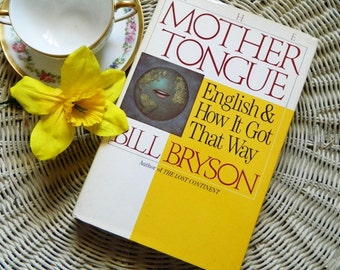
      While rummaging through book at home, I happened across the book shown above. The title immediately sparked my interest (after all, English is my mother tongue). I am hoping that The Mother Tongue will add to my knowledge of English, the universal language, and allow me to become a better writer. I have lots of high expectations, considering my parents praised this book highly when I told them I was going to read it. On top of that, the back of the book reads:

      "Bill Bryson has joyfully mined the rich ore of English to produce a treasure of a book about the treasure of our tongue." --Richard Lederer, author of Crazy English

      Bill Bryson was an American journalist who worked for The Times, in London, and The Independent. He wrote many bestselling travel books, including The Lost Continent, which documented his journey around the United States from 1987 to 1988. His books include A Dictionary of Troublesome Words, A Walk in the Woods, and A Short History of Nearly Everything.

      I will also be starting a "beautiful-word-definition" for the posts of The Mother Tongue (I find doing this is relevant to the book), so here we go:


      Links:

      Picture Source ("The Mother Tongue"): https://img0.etsystatic.com/032/0/6776881/il_340x270.570389374_jz2c.jpg
      Picture Souce ("fernweh"): http://img.pandawhale.com/post-25612-fernweh-meaning-gif-aDM0.gif